Enter your email address
Submit




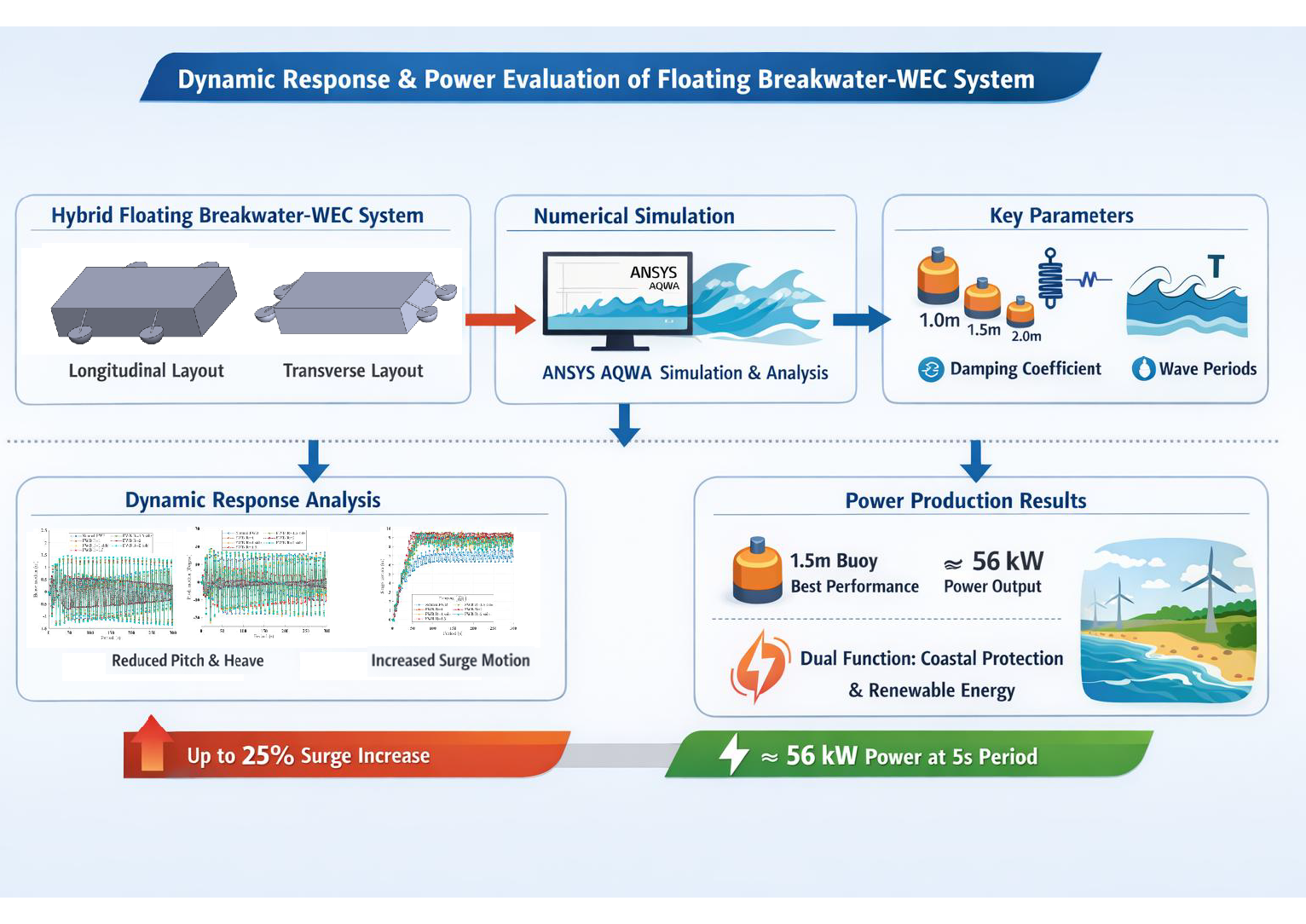
| In coastal and offshore engineering, floating breakwaters are widely recognized as effective solutions for attenuating wave energy and protecting coastal infrastructure. However, the development of modern technologies has enabled these structures to simultaneously function as renewable energy systems. The goal of this study is to investigate the performance of a hybrid system consisting of a rectangular floating breakwater integrated with wave energy converters (WECs) of different sizes and configurations, aiming to enhance both coastal protection and energy generation. To achieve this, numerical simulations were conducted using ANSYS AQWA software, based on potential flow theory and wave diffraction analysis. Three different buoy diameters for the WECs and two distinct layouts (longitudinal and transverse) were examined. Additionally, the best damping coefficient for each converter was determined to maximize power extraction. The novelty of this work lies in combining the dynamic response analysis of a floating breakwater with a quantitative evaluation of power output while simultaneously assessing the effects of WEC size and arrangement. The findings reveal that the installation of WECs not only reduces pitch and heaving motions but also slightly increases surge motion by up to 25% in some configurations. The best performance was seen for a 1.5-meter buoy diameter in the longitudinal arrangement, capable of producing approximately 56 kW of power at a wave period of 5 seconds. Overall, the results confirm that the proposed hybrid floating breakwater–WEC system can serve as a dual-purpose solution, simultaneously providing coastal protection and renewable energy generation. |
| Rights and permissions | |
 |
This work is licensed under a Creative Commons Attribution-NonCommercial 4.0 International License. |


International Journal of Maritime Technology is licensed under a
Creative Commons Attribution-NonCommercial 4.0 International License.