Write your message
Volume 21, Issue 48 (12-2025)                   marineeng 2025, 21(48): 78-94 | Back to browse issues page

XML Persian Abstract Print


Download citation:
BibTeX | RIS | EndNote | Medlars | ProCite | Reference Manager | RefWorks
Send citation to:

Akrami M, Abazari A. Dynamic Response Analysis and Power Production Evaluation of a Combined Floating Breakwater–Wave Energy Converter System. marineeng 2025; 21 (48) :78-94
URL: http://marine-eng.ir/article-1-1189-en.html
1- Chabahar maritime university
Abstract:   (348 Views)
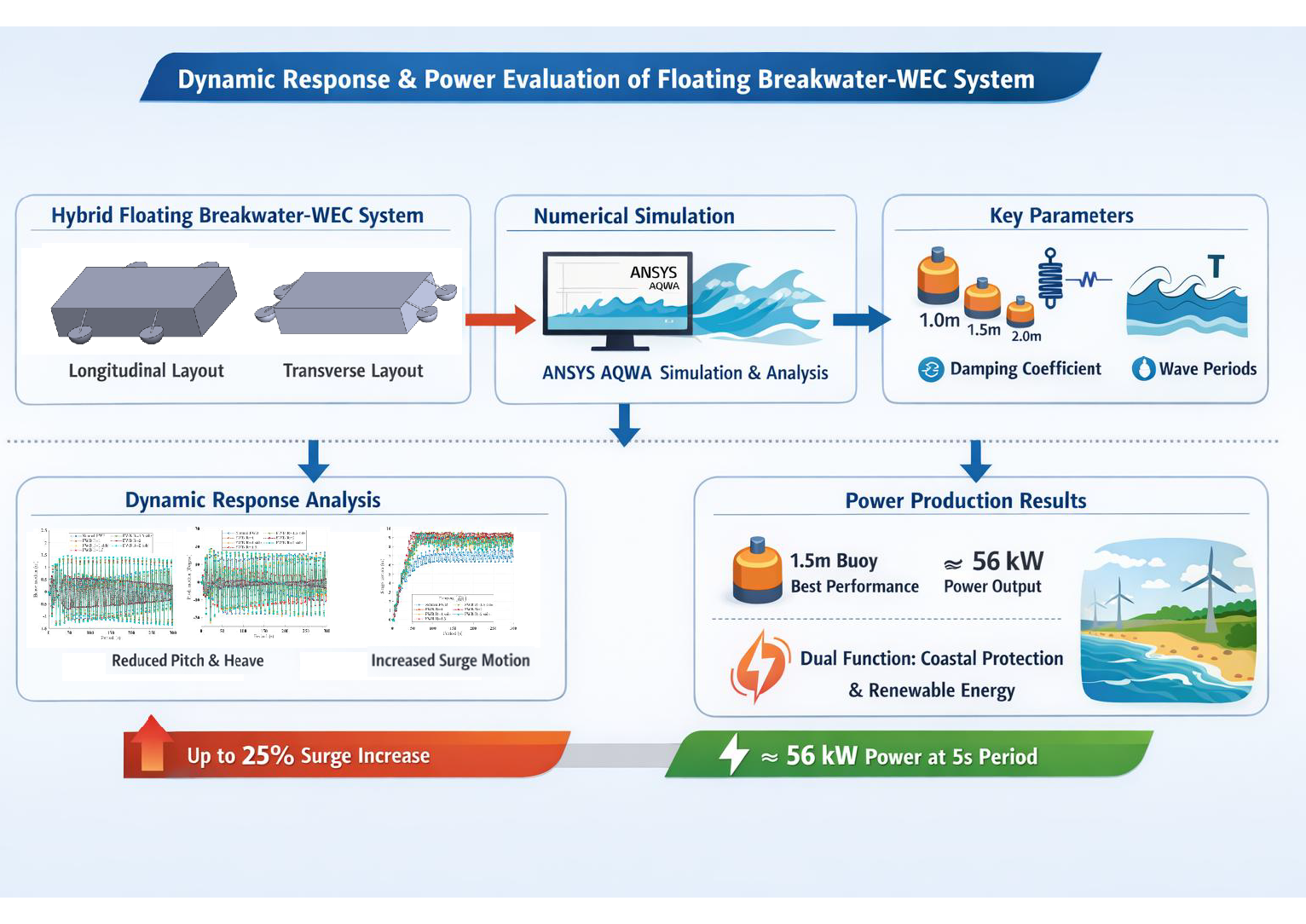
In coastal and offshore engineering, floating breakwaters are widely recognized as effective solutions for attenuating wave energy and protecting coastal infrastructure. However, the development of modern technologies has enabled these structures to simultaneously function as renewable energy systems. The goal of this study is to investigate the performance of a hybrid system consisting of a rectangular floating breakwater integrated with wave energy converters (WECs) of different sizes and configurations, aiming to enhance both coastal protection and energy generation. To achieve this, numerical simulations were conducted using ANSYS AQWA software, based on potential flow theory and wave diffraction analysis. Three different buoy diameters for the WECs and two distinct layouts (longitudinal and transverse) were examined. Additionally, the best damping coefficient for each converter was determined to maximize power extraction. The novelty of this work lies in combining the dynamic response analysis of a floating breakwater with a quantitative evaluation of power output while simultaneously assessing the effects of WEC size and arrangement. The findings reveal that the installation of WECs not only reduces pitch and heaving motions but also slightly increases surge motion by up to 25% in some configurations. The best performance was seen for a 1.5-meter buoy diameter in the longitudinal arrangement, capable of producing approximately 56 kW of power at a wave period of 5 seconds. Overall, the results confirm that the proposed hybrid floating breakwater–WEC system can serve as a dual-purpose solution, simultaneously providing coastal protection and renewable energy generation.
Full-Text [PDF 2625 kb]   (88 Downloads)    

Highlights 
  • Development of a hybrid floating breakwater–wave energy converter system with dual functionality: coastal protection and renewable energy generation.
  • Optimization of damping coefficients for 1 m, 1.5 m, and 2 m buoys based on maximizing the area under the power–period curve.
  • Achievement of approximately 56 kW power output at a 5 s wave period (best case: 1.5 m buoy, longitudinal layout).
  • Significant reduction of dynamic responses, including up to 50% heave reduction and 70% pitch reduction in the optimal configuration.
  • Demonstration of the critical role of buoy size and arrangement in balancing structural stability and energy efficiency.

 
Type of Study: Research Paper | Subject: Offshore Hydrodynamic
Received: 2025/05/24 | Accepted: 2026/03/28

References
1. Ning, D., et al., (2016), Hydrodynamic performance of a pile-restrained WEC-type floating breakwater: An experimental study, Journal, Vol.95, p.531-541. [DOI:10.1016/j.renene.2016.04.057]
2. Rezaei Mazik, A., et al., (2017), Pattern of Wave Height Variations Around a Floating Pontoon Breakwater, Journal, Vol.16, p.29-45. [DOI:10.22113/jmst.2017.50586]
3. Gotoh, H. and A. Khayyer. (2018), On the state-of-the-art of particle methods for coastal and ocean engineering, Journal, Vol.60, p.79-103. [DOI:10.1080/21664250.2018.1436243]
4. Marchesi, E., M. Negri, and S. Malavasi. (2020), Development and analysis of a numerical model for a two-oscillating-body wave energy converter in shallow water, Journal, Vol.214, p.107765. [DOI:10.1016/j.oceaneng.2020.107765]
5. Nemati, S., M. Bakhtiari, and M. Azami Ali Abady. (2021), Investigation of Wave-Structure Interaction in Floating Breakwaters, Journal, Vol.5, p.8-21. [DOI:10.22111/JHE.2022.42343.1079]
6. Abazari, A., M.R. Zareei, and S. Poursheikhali. (2021), Determination of the power resonant frequency of an OWC converter based on the RLC circuit analytical approach, Journal, Vol.16, p.93-105. https://dor.isc.ac/dor/20.1001.1.23456000.2021.16.0.12.7
7. Rajabi, M. and H. Ghassemi. (2021), Hydrodynamic Performance Improvement of Double-Row Floating Breakwaters by Changing the Cross-Sectional Geometry, Journal, Vol.2021, p.1-21. [DOI:10.1155/2021/2944466]
8. Gallutia, D., et al., (2022), Recent advances in wave energy conversion systems: From wave theory to devices and control strategies, Journal, Vol.252, p.111105. [DOI:10.1016/j.oceaneng.2022.111105]
9. Ghafari, H.R., H. Ghassemi, and A. Neisi. (2022), Power matrix and dynamic response of the hybrid Wavestar-DeepCwind platform under different diameters and regular wave conditions, Journal, Vol.247, p.110734. [DOI:10.1016/j.oceaneng.2022.110734]
10. Yousefi, S., A. Mahmoudi, and S. Hajizadeh. (2023), Investigating the effect of using a Lateral duct in the body of a floating breakwater by numerical method, Journal, Vol.18, p.89-104. http://doi.org/10.52547/marineeng.18.37.89 [DOI:10.52547/marineeng.18.37.89]
11. Dorostkar, R., A. Abazari, and A. Ebrahimi. (2022), Energy harvesting through an integrated design of a semi-submersible offshore platform with point absorber wave energy converters, Journal, Vol.7, p.27-36. [DOI:10.22034/ijcoe.2022.166735]
12. Yousefi, S., A. Mahmoudi, and S. Hajizadeh. (2023), Numerical Investigation into Effect Section Geometry parameters of Floating Breakwaters in single and double rows on its Hydrodynamics performance, Journal, Vol.19, p.35-49. http://doi.org/10.61186/marineeng.19.39.35 [DOI:10.61186/marineeng.19.39.35]
13. Azami, M., M. Bakhtiari, and H. Bahrami. (2023), Numerical investigation of the effect of geometric and hydrodynamic parameters of waves on the performance of rectangular floating pontoon breakwater structure, Journal, Vol.3, p.42-60. [DOI:10.22126/atwe.2023.9049.1049]
14. Jokar, H., A. Abazari, and R. Dorostkar. (2024), Performance evaluation of a hybrid system of dhow ship and wave energy converter for power generation, Journal, Vol., p. [DOI:10.22044/rera.2024.13737.1264]
15. Kamal, F., A. Abazari, and R. Dorostkar. (2024), The effect of flap dimension and wave angle on the dynamic response and extracted power of the hybrid system of offshore wind turbine and surge oscillating converter, Journal, Vol.20, p.1-12. http://doi.org/10.61186/marineeng.20.42.1 [DOI:10.61186/marineeng.20.42.1]
16. Abazari, A., (2023), Dynamic response of a combined spar-type FOWT and OWC-WEC by a simplified approach, Journal, Vol.4, p.66-77. [DOI:10.22044/rera.2022.11768.1109]
17. Gharechae, A., A. Abazari, and K. Soleimani. (2024), Performance assessment of a combined circular aquaculture cage floater and point absorber wave energy converters, Journal, Vol.300, p.117239. [DOI:10.1016/j.oceaneng.2024.117239]
18. Zhou, B., et al., (2024), Experimental study of a WEC array-floating breakwater hybrid system in multiple-degree-of-freedom motion, Journal, Vol.371, p.123694. [DOI:10.1016/j.apenergy.2024.123694]
19. Alireza Aghalari, A.P., Morteza Shahrouyi. (2019), Specialized Book Series on Ansys Workbench: Analysis of Marine Floating Structures Using Aqwa and Ansys Workbench Software, Journal, Vol., p.242.

Send email to the article author


Rights and permissions
Creative Commons License This work is licensed under a Creative Commons Attribution-NonCommercial 4.0 International License.

Creative Commons License
International Journal of Maritime Technology is licensed under a

Creative Commons Attribution-NonCommercial 4.0 International License.