پیام خود را بنویسید
دوره 21، شماره 48 - ( 10-1404 )                   جلد 21 شماره 48 صفحات 94-78 | برگشت به فهرست نسخه ها

XML English Abstract Print


Download citation:
BibTeX | RIS | EndNote | Medlars | ProCite | Reference Manager | RefWorks
Send citation to:

Akrami M, Abazari A. Dynamic Response Analysis and Power Production Evaluation of a Combined Floating Breakwater–Wave Energy Converter System. marineeng 2025; 21 (48) :78-94
URL: http://marine-eng.ir/article-1-1189-fa.html
اکرمی محمد، اباذری ابوذر. تحلیل پاسخ دینامیکی و ارزیابی توان تولیدی سیستم ترکیبی موج‌شکن شناور و مبدل انرژی موج. مهندسی دریا. 1404; 21 (48) :78-94

URL: http://marine-eng.ir/article-1-1189-fa.html


1- دانشگاه دریانوردی و علوم دریایی چابهار
چکیده:   (421 مشاهده)
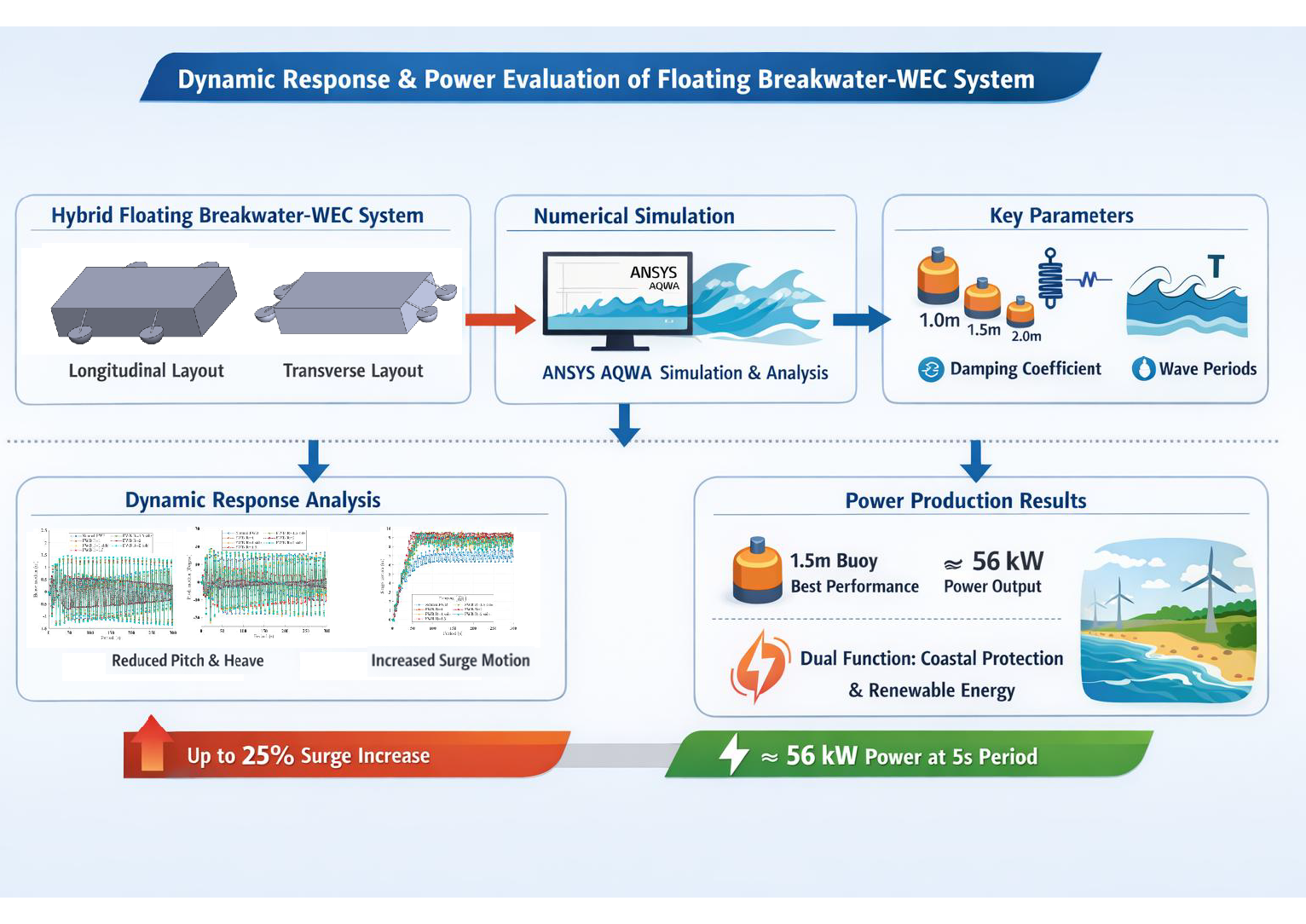
در مهندسی سواحل و فراساحل، سازه‌های موج‌شکن شناور به‌عنوان راهکاری کارآمد برای کاهش انرژی امواج و حفاظت از زیرساخت‌های ساحلی شناخته می‌شوند. بااین‌حال، توسعه فناوری‌های نوین امکان بهره‌برداری هم‌زمان از این سازه‌ها در تولید انرژی پاک را فراهم کرده است. هدف پژوهش حاضر بررسی عملکرد یک سیستم ترکیبی شامل موج‌شکن شناور مستطیلی همراه با مبدل‌های انرژی موج در ابعاد و چیدمان‌های مختلف است تا ضمن ارتقای کارایی حفاظتی، قابلیت تولید انرژی نیز ارزیابی شود. برای دستیابی به این هدف، مدل‌سازی عددی با استفاده از نرم‌افزار انسیس آکوا مبتنی بر تئوری پتانسیل و تحلیل تفرق امواج انجام گرفت. در این مطالعه سه اندازه متفاوت از بویه‌های مبدل انرژی و دو نوع آرایش طولی و عرضی آن‌ها روی موج‌شکن بررسی شدند. همچنین، برای مبدل‌ها ضریب میرایی بهینه محاسبه شد تا بیشترین بازده توان خروجی حاصل شود. نوآوری این تحقیق در ترکیب تحلیل دینامیکی موج‌شکن شناور با ارزیابی کمی تولید انرژی و بررسی اثر هم‌زمان ابعاد و نحوه استقرار مبدل‌ها است. یافته‌ها نشان داد که استفاده از مبدل‌های انرژی علاوه بر کاهش نسبی حرکات پیچ و هیو، در برخی چیدمان‌ها موجب افزایش حرکت سرج تا حدود 2۵ درصد می‌شود. بهترین عملکرد مربوط به بویه با قطر ۵/۱ متر در چیدمان طولی بوده است که توان تولیدی آن در پریود ۵ ثانیه حدود ۵۶ کیلووات برآورد شد. در مجموع، نتایج نشان می‌دهد که سیستم ترکیبی موج‌شکن - مبدل انرژی قابلیت ایفای نقش دوگانه در حفاظت سواحل و تولید انرژی تجدیدپذیر را دارد.
متن کامل [PDF 2625 kb]   (99 دریافت)    

نکات برجسته 
  • ارائه یک سیستم ترکیبی موج‌شکن شناورمبدل انرژی با عملکرد دوگانه حفاظت ساحلی و تولید انرژی.
  • تعیین میرایی بهینه برای بویه‌های ۱، ۱٫۵ و ۲ متر بر اساس بیشینه‌سازی توان تجمعی.
  • دستیابی به توان حدود ۵۶ کیلووات در پریود ۵ ثانیه (بهترین حالت: بویه ۱٫۵ متر، چیدمان طولی).
  • کاهش چشمگیر پاسخ‌های دینامیکی؛ تا ۵۰٪ کاهش هیو و ۷۰٪ کاهش پیچ در حالت بهینه.
  • نشان دادن نقش کلیدی ابعاد بویه و نوع چیدمان در ایجاد تعادل بین پایداری سازه و بازده انرژی.

نوع مطالعه: مقاله پژوهشي | موضوع مقاله: هیدروديناميك سازه های ساحلی و فراساحلی
دریافت: 1404/3/3 | پذیرش: 1405/1/8

فهرست منابع
1. Ning, D., et al., (2016), Hydrodynamic performance of a pile-restrained WEC-type floating breakwater: An experimental study, Journal, Vol.95, p.531-541. [DOI:10.1016/j.renene.2016.04.057]
2. Rezaei Mazik, A., et al., (2017), Pattern of Wave Height Variations Around a Floating Pontoon Breakwater, Journal, Vol.16, p.29-45. [DOI:10.22113/jmst.2017.50586]
3. Gotoh, H. and A. Khayyer. (2018), On the state-of-the-art of particle methods for coastal and ocean engineering, Journal, Vol.60, p.79-103. [DOI:10.1080/21664250.2018.1436243]
4. Marchesi, E., M. Negri, and S. Malavasi. (2020), Development and analysis of a numerical model for a two-oscillating-body wave energy converter in shallow water, Journal, Vol.214, p.107765. [DOI:10.1016/j.oceaneng.2020.107765]
5. Nemati, S., M. Bakhtiari, and M. Azami Ali Abady. (2021), Investigation of Wave-Structure Interaction in Floating Breakwaters, Journal, Vol.5, p.8-21. [DOI:10.22111/JHE.2022.42343.1079]
6. Abazari, A., M.R. Zareei, and S. Poursheikhali. (2021), Determination of the power resonant frequency of an OWC converter based on the RLC circuit analytical approach, Journal, Vol.16, p.93-105. https://dor.isc.ac/dor/20.1001.1.23456000.2021.16.0.12.7
7. Rajabi, M. and H. Ghassemi. (2021), Hydrodynamic Performance Improvement of Double-Row Floating Breakwaters by Changing the Cross-Sectional Geometry, Journal, Vol.2021, p.1-21. [DOI:10.1155/2021/2944466]
8. Gallutia, D., et al., (2022), Recent advances in wave energy conversion systems: From wave theory to devices and control strategies, Journal, Vol.252, p.111105. [DOI:10.1016/j.oceaneng.2022.111105]
9. Ghafari, H.R., H. Ghassemi, and A. Neisi. (2022), Power matrix and dynamic response of the hybrid Wavestar-DeepCwind platform under different diameters and regular wave conditions, Journal, Vol.247, p.110734. [DOI:10.1016/j.oceaneng.2022.110734]
10. Yousefi, S., A. Mahmoudi, and S. Hajizadeh. (2023), Investigating the effect of using a Lateral duct in the body of a floating breakwater by numerical method, Journal, Vol.18, p.89-104. http://doi.org/10.52547/marineeng.18.37.89 [DOI:10.52547/marineeng.18.37.89]
11. Dorostkar, R., A. Abazari, and A. Ebrahimi. (2022), Energy harvesting through an integrated design of a semi-submersible offshore platform with point absorber wave energy converters, Journal, Vol.7, p.27-36. [DOI:10.22034/ijcoe.2022.166735]
12. Yousefi, S., A. Mahmoudi, and S. Hajizadeh. (2023), Numerical Investigation into Effect Section Geometry parameters of Floating Breakwaters in single and double rows on its Hydrodynamics performance, Journal, Vol.19, p.35-49. http://doi.org/10.61186/marineeng.19.39.35 [DOI:10.61186/marineeng.19.39.35]
13. Azami, M., M. Bakhtiari, and H. Bahrami. (2023), Numerical investigation of the effect of geometric and hydrodynamic parameters of waves on the performance of rectangular floating pontoon breakwater structure, Journal, Vol.3, p.42-60. [DOI:10.22126/atwe.2023.9049.1049]
14. Jokar, H., A. Abazari, and R. Dorostkar. (2024), Performance evaluation of a hybrid system of dhow ship and wave energy converter for power generation, Journal, Vol., p. [DOI:10.22044/rera.2024.13737.1264]
15. Kamal, F., A. Abazari, and R. Dorostkar. (2024), The effect of flap dimension and wave angle on the dynamic response and extracted power of the hybrid system of offshore wind turbine and surge oscillating converter, Journal, Vol.20, p.1-12. http://doi.org/10.61186/marineeng.20.42.1 [DOI:10.61186/marineeng.20.42.1]
16. Abazari, A., (2023), Dynamic response of a combined spar-type FOWT and OWC-WEC by a simplified approach, Journal, Vol.4, p.66-77. [DOI:10.22044/rera.2022.11768.1109]
17. Gharechae, A., A. Abazari, and K. Soleimani. (2024), Performance assessment of a combined circular aquaculture cage floater and point absorber wave energy converters, Journal, Vol.300, p.117239. [DOI:10.1016/j.oceaneng.2024.117239]
18. Zhou, B., et al., (2024), Experimental study of a WEC array-floating breakwater hybrid system in multiple-degree-of-freedom motion, Journal, Vol.371, p.123694. [DOI:10.1016/j.apenergy.2024.123694]
19. Alireza Aghalari, A.P., Morteza Shahrouyi. (2019), Specialized Book Series on Ansys Workbench: Analysis of Marine Floating Structures Using Aqwa and Ansys Workbench Software, Journal, Vol., p.242.

ارسال پیام به نویسنده مسئول


بازنشر اطلاعات
Creative Commons License این مقاله تحت شرایط Creative Commons Attribution-NonCommercial 4.0 International License قابل بازنشر است.

Creative Commons License
International Journal of Maritime Technology is licensed under a

Creative Commons Attribution-NonCommercial 4.0 International License.