پیام خود را بنویسید

XML English Abstract Print


1- دانشجو
2- عضو هیئت علمی
چکیده:   (65 مشاهده)
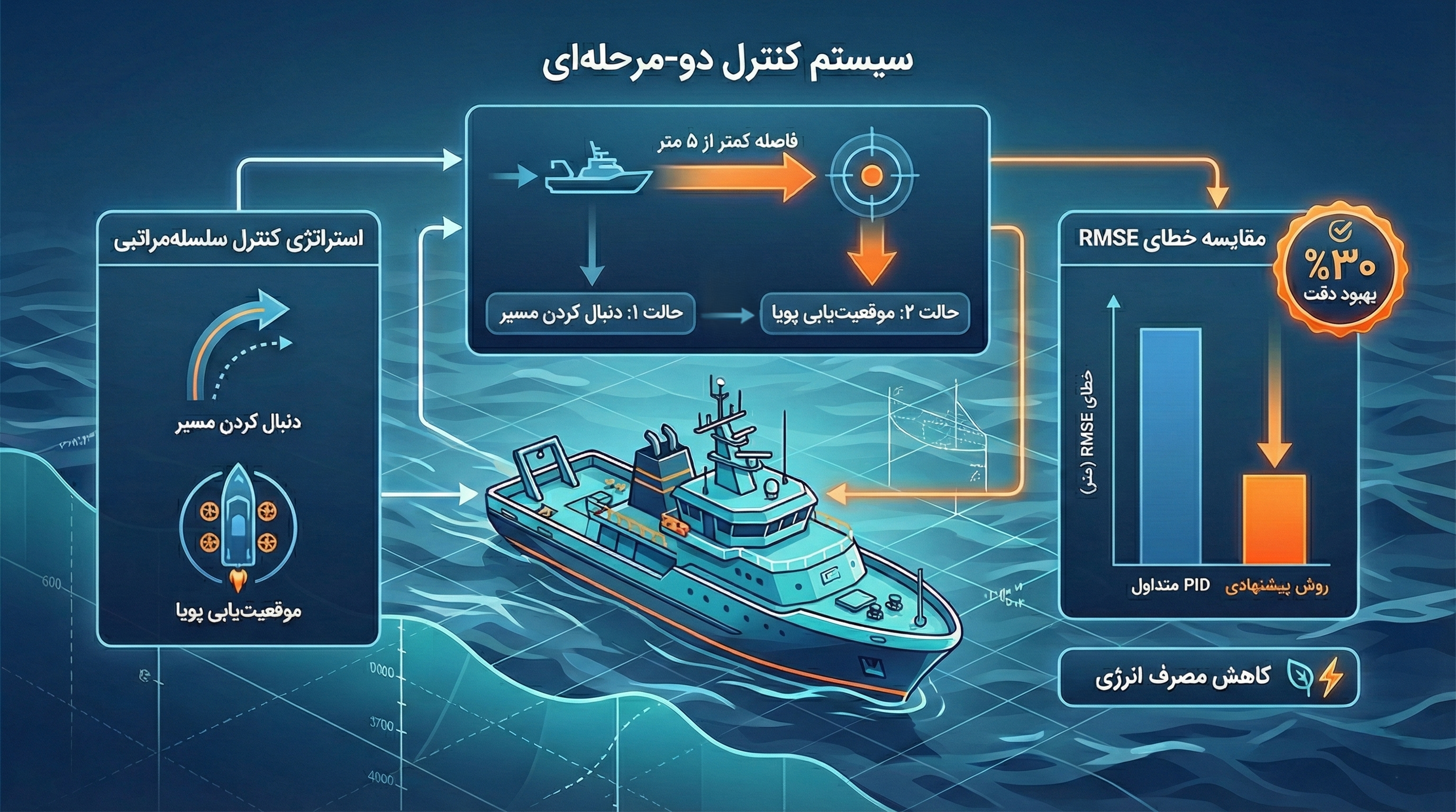
سیستم‌های تثبیت موقعیت پویا (DP) به‌واسطه دینامیک غیرخطی شناور و اغتشاشات محیطی (مانند باد، جریان، و موج) با چالش‌های کنترلی مواجه‌اند. این مسائل، در کنار فعالیت پیوسته و حالت آماده‌باش تراسترها، موجب افزایش چشمگیر مصرف انرژی و هزینه‌های عملیاتی در سیستم‌های متعارف می‌شوند.  این مقاله، بهبود عملکرد DP شناورها را با معرفی یک الگوریتم کنترلی سلسله‌مراتبی و پایدار، که به‌طور هم‌زمان پایداری دینامیکی و دقت موقعیت‌یابی را تضمین می‌کند، هدف قرار داده است. در این ساختار، فاز نخست (Path Following)، در فواصل زیاد از هدف (بیش از ۵ متر)، با استفاده از کنترلر PD برای هدایت سریع و بهینه‌سازی مصرف انرژی عمل می‌کند. پس از نزدیک شدن شناور به موقعیت هدف، فاز دوم (Dynamic Positioning) با کنترلر PID برای تثبیت دقیق موقعیت و جهت فعال می‌شود. نتایج شبیه‌سازی سه‌درجه‌آزادی بر روی شناور مدل KVLCC2، عملکرد پایدار و مقاوم سیستم پیشنهادی را در چهار سناریوی مختلف، با حداکثر خطای تثبیت موقعیت 19 سانتی‌متر (10% طول شناور) نشان می‌دهد. در سناریوهای فاقد اغتشاش محیطی، گذار نرم و همگرایی سریع از (۰,۰) به (۲۰,۲۰) متر مشاهده شد. همچنین در حضور اغتشاشات محیطی شدید، عملکرد تثبیت موقعیت سیستم پیشنهادی بر اساس معیار RMSE (ریشه میانگین مربعات خطا با ثبت مقدار 27/0 متر، بهبود میانگین 30% را نسبت به یک کنترلر PID نشان داده است. افزون بر این، فعال‌سازی سیستم DP دقیق در مرحله دوم، موجب کاهش مؤثر مصرف انرژی و هزینه‌های عملیاتی شده است.
متن کامل [PDF 1592 kb]   (28 دریافت)    

نکات برجسته مقاله:
  1. طراحی و پیاده‌سازی یک سیستم کنترل دومرحله‌ای (سلسله مراتبی) برای حل چالش‌های پایداری و مصرف انرژی در سیستم‌های DP سنتی.
  2. استفاده از ترکیب کنترلر PD در فاز دنبال کردن مسیر (Path Following) و کنترلر PID در فاز تثبیت موقعیت (Dynamic Positioning) برای بهینه‌سازی عملکرد.
  3. کاهش قابل توجه مصرف انرژی پیشران‌ها و تضمین پایداری دینامیکی در تمام مراحل عملیات DP.
  4. دستیابی به ۳0% بهبود در عملکرد (کاهش خطای ریشه میانگین مربعات) در مقایسه با روش‌های کنترل PID تک‌مرحله‌ای رایج.
  5. تثبیت موقعیت دقیق شناور مدل KVLCC2 با حداکثر خطای ۱۹ سانتی‌متر (10% طول شناور)در حالت پایدار در برابر اغتشاشات محیطی شدید.

نوع مطالعه: مقاله پژوهشي | موضوع مقاله: هیدرودینامیک عددی
دریافت: 1404/7/23 | پذیرش: 1404/9/18

فهرست منابع
1. Lau, Y.Y., Chen, Q., Poo, M.C.P., Ng, A.K. and Ying,C.C., (2024). Maritime transport resilience: A systematic literature review on the current state of the art, research agenda and future research directions. Ocean & Coastal Management, 251, p.107086. https://doi.org/10.1016/j.ocecoaman.2024.107086 [DOI:10.1016/j.ocecoaman.2024.107086.]
2. Huang, H.M., (2004). Autonomy levels for unmanned systems (ALFUS) framework volume I: Terminology version 2.0. https://doi.org/10.6028/NIST.SP.1011-I-2.0 [DOI:10.6028/NIST.sp.1011-I-2.0]
3. Sørensen, A.J., Sagatun, S.I. and Fossen, T.I., (1996). Design of a dynamic positioning system using model-based control. Control Engineering Practice, 4(3), pp.359-368. https://doi.org/10.1016/0967-0661(96)00013-5 [DOI:10.1016/09670661(96)00013-5]
4. Peng, Z., Wang, D. and Wang, J., (2015). Cooperative dynamic positioning of multiple marine offshore vessels: A modular design. IEEE/ASME Transactions On Mechatronics, 21(3), pp.1210-1221. https://doi.org/10.1109/TMECH.2015.2508647 [DOI:10.1016/09670661(96)00013-5]
5. Gao, X. and Li, T., (2024). Dynamic positioning control for marine crafts: a survey and recent advances. Journal of Marine Science and Engineering, 12(3), p.362. [DOI:10.3390/jmse12030362]
6. Li, J., Huang, W., Huang, C. and Zhang, G., (2025). Enhancing Robust Adaptive Dynamic Positioning of Full-Actuated Surface Vessels: Reinforcement Learning Approach for Unknown Hydrodynamics. Journal of Marine Science and Engineering, 13(5), p.993. [DOI:10.3390/jmse13050993]
7. Tannuri, E.A., Agostinho, A.C., Morishita, H.M. and Moratelli Jr, L., (2010). Dynamic positioning systems: An experimental analysis of sliding mode control. Control engineering practice, 18(10),pp. 1121-1132. [DOI:10.1016/j.conengprac.2010.06.007]
8. Fu, M., Ning, J. and Wei, Y., (2011). Fault-tolerant control of dynamic positioning vessel by means of a virtual thruster. IEEE International Conference on Mechatronics and Automation (pp. 1706-1710). [DOI:10.1109/ICMA.2011.5986367]
9. Walmsness, J.E., Helgesen, H.H., Larsen, S., Kufoalor, G.K.M. and Johansen, T.A., (2023). Automatic dock-to-dock control system for surface vessels using bumpless transfer. Ocean Engineering, 268,p.113425. [DOI:10.1016/j.oceaneng.2023.114852]
10. Agostinho, A.C., Moratelli Jr, L., Tannuri, E.A. and Morishita, H.M., (2009). Sliding mode control applied to offshore dynamic positioning systems. IFAC Proceedings Volumes, 42(18), pp.237-242. https://doi.org/10.3182/20090916-3-BR-3001.0009 [DOI:10.3182/200909163BR3001.0009]
11. Fu, M., Ning, J. and Wei, Y., (2011), August. Fault-tolerant control of dynamic positioning vessel by means of a virtual thruster. IEEE International Conference on Mechatronics and Automation (pp. 1706-1710). [DOI:10.1109/ICMA.2011.5986367]
12. Seif, M.S., (2023). Designing the way point tracking intelligent system for displacement vessels with considering nonlinear dynamics. Journal Of Marine Engineering, 19(38), pp.155-167. (In Persian)http://dx.doi.org/10.61186/marineeng.19.38.155 [DOI:10.61186/marineeng.19.38.155]
13. Najari, A. and Seif, M.S., (2025). Dynamic modeling of surface vessel maneuvering based on deep learning using recurrent neural networks. Journal Of Marine Engineering, 21(46), pp.80-88. (In Persian)http://dx.doi.org/10.61882/marineeng.21.46.7 [DOI:10.61882/marineeng.21.46.7]

ارسال پیام به نویسنده مسئول


بازنشر اطلاعات
Creative Commons License این مقاله تحت شرایط Creative Commons Attribution-NonCommercial 4.0 International License قابل بازنشر است.

Creative Commons License
International Journal of Maritime Technology is licensed under a

Creative Commons Attribution-NonCommercial 4.0 International License.