1. He, Y., Wang, D. B., and Ali, Z. A. (2020). A review of different designs and control models of remotely operated underwater vehicle. Measurement and Control, vol. 53, no. 9-10, pp. 1561-1570, doi:
https://doi.org/10.1177/0020294020952483 [
DOI:10.1177/0020294020952483.]
2. Khodabandehloo far, J., Najari, A., soleymani, s., and Seif, M. S. (2025). Improving Dynamic Positioning (DP) System Performance Using a Two-Stage Control System. Marine-Engineering, vol. 21, no. 47, p. 108, doi: https://dx.doi.org/10.1109/TSMC.2019.289638210.66224/marineeng.21.47.9. (In Persian) [
DOI:10.66224/marineeng.21.47.9]
3. Fossen, T. I. (2021). Handbook of Marine Craft Hydrodynamics and Motion Control. Wiley. [
DOI:10.1002/9781119575016]
4. Lack, S., Rentzow, E., and Jeinsch, T. (2019). Experimental Parameter Identification for an open-frame ROV: Comparison of towing tank tests and open water self-propelled tests. IFAC-PapersOnLine, vol. 52, no. 21, pp. 271-276, doi:
https://doi.org/10.1016/j.ifacol.2019.12.319 [
DOI:10.1016/j.ifacol.2019.12.319.]
5. Zohedi, F. N., Mohd Aras, M. S., Kasdirin, H. A., Bahar, M. B., and Abdullah, L. (2023). System identification modelling, controller design and hardware testing for vertical trajectory of underwater remotely operated vehicle (ROV). IIUM Engineering Journal, vol. 24, no. 2, pp. 131 - 140, doi:
https://doi.org/10.31436/iiumej.v24i2.2759 [
DOI:10.31436/iiumej.v24i2.2759.]
6. Najari, A. and Seif, M. S. (2025). Dynamic modeling of surface vessel maneuvering based on deep learning using recurrent neural networks. Marine-Engineering, vol. 21, no. 46, p. 80, doi:
https://doi.org/10.61882/marineeng.21.46.7 [
DOI:10.61882/marineeng.21.46.7. (In Persian)]
7. Hasanvand, A. and Seif, M. s. (2023). Parametric Study of Sut Glider: Investigating Hydrodynamic Performance and Maneuverability. Modares Mechanical Engineering, vol. 23, no. 3, pp. 173-182, doi:
https://doi.org/10.52547/mme.23.3.173 [
DOI:10.52547/mme.23.3.173. (In Persian)]
8. Walker, K. L. et al. (2021). Experimental Validation of Unsteady Wave Induced Loads on a Stationary Remotely Operated Vehicle. in 2021 IEEE International Conference on Robotics and Automation (ICRA), pp. 2242-2248, doi: https://dx.doi.org/10.1109/ICRA48506.2021.9562010. [
DOI:10.1109/ICRA48506.2021.9562010]
9. Batmani, Y. and Najafi, S. (2021). Event-Triggered H∞ Depth Control of Remotely Operated Underwater Vehicles. IEEE Transactions on Systems, Man, and Cybernetics: Systems, vol. 51, no. 2, pp. 1224-1232, doi: https://dx.doi.org/10.1109/TSMC.2019.2896382. [
DOI:10.1109/TSMC.2019.2896382]
10. Bellahcene, Z., Laidani, A., Belherazem, A., and Bouhamida, M. (2025). Robust Adaptive Controller Design Based on Neural Networks for a Remotely Operated Underwater Vehicle (ROV). Automatic Control and Computer Sciences, vol. 59, no. 4, pp. 467-480, doi: https://dx.doi.org/10.1109/TSMC.2019.289638210.3103/S0146411625700622. [
DOI:10.3103/S0146411625700622]
11. Nguyen, K. H., Caharija, W., Ohrem, S. J., Gravdahl, J. T., Loría, A., and Amundsen, H. B. (2026). Robust Control of Autonomous Remotely Operated Vehicles at Exposed Aquaculture Sites. IEEE Transactions on Control Systems Technology, vol. 34, no. 3, pp. 1232-1247, doi: https://dx.doi.org/10.1109/TSMC.2019.289638210.1109/TCST.2026.3662005 . [
DOI:10.1109/TCST.2026.3662005]
12. Dong, J. and Duan, X. (2023). A Robust Control via a Fuzzy System with PID for the ROV. Sensors, vol. 23, no. 2, p. 821, doi: https://dx.doi.org/10.3390/s23020821. [
DOI:10.3390/s23020821] [
PMID] [
PMCID]
13. Svendby, E. (2007). Robust control of ROV/AUVs. Master's Thesis, Institutt for Teknisk Kybernetikk.
14. García-Valdovinos, L. G., Salgado-Jiménez, T., Bandala-Sánchez, M., Nava-Balanzar, L., Hernández-Alvarado, R., and Cruz-Ledesma, J. A. (2014). Modelling, Design and Robust Control of a Remotely Operated Underwater Vehicle. International Journal of Advanced Robotic Systems, vol. 11, no. 1, p. 1, doi: https://dx.doi.org/10.5772/56810. [
DOI:10.5772/56810]
15. Cao, Y., Li, B., Li, Q., Stokes, A. A., Ingram, D. M., and Kiprakis, A. (2020). A Nonlinear Model Predictive Controller for Remotely Operated Underwater Vehicles With Disturbance Rejection. IEEE Access, vol. 8, pp. 158622-158634, doi: https://dx.doi.org/10.1109/ACCESS.2020.3020530 . [
DOI:10.1109/ACCESS.2020.3020530]
16. Ibrahim, M. Y., Rehan, A., Chehadeh, M., Boiko, I., and Zweiri, Y. (2027). Identification and control of ROV attitude and heave: A compact approach using Modified Relay Feedback Test. Mechatronics, vol. 121, p. 103612, doi:
https://doi.org/10.1016/j.mechatronics.2026.103612 [
DOI:10.1016/j.mechatronics.2026.103612.]
17. Society of Naval, T. Marine Engineers, and S. Research Committee (1950). Hydrodynamics, Nomenclature for Treating the Motion of a Submerged Body Through a Fluid: Report of the American Towing Tank Conference (Technical and research bulletin). Society of Naval Architects and Marine Engineers.
18. Rasouli,A. Nasiri,H. (2018). Design and Manufacture Pipeline monitoring ROV. Sharif Univercity of Technology. (In Persian)
19. Ljung, L. (1999). System Identification: Theory for the User (Prentice Hall information and system sciences series). Prentice Hall PTR.
20. Hartley, H. O. (1961). The Modified Gauss-Newton Method for the Fitting of Non-Linear Regression Functions by Least Squares. Technometrics, vol. 3, no. 2, pp. 269-280, doi: https://dx.doi.org/10.2307/1266117. [
DOI:10.2307/1266117]
21. Postlethwaite, I. (1996). Multivariable feedback control: analysis and design. John Wiley & Sons, Inc.
22. Wang, P., Tian, X., Lu, W., Hu, Z., and Luo, Y. (2019). Dynamic modeling and simulations of the wave glider. Applied Mathematical Modelling, vol. 66, pp. 77-96, doi:
https://doi.org/10.1016/j.apm.2018.08.027 [
DOI:10.1016/j.apm.2018.08.027.]




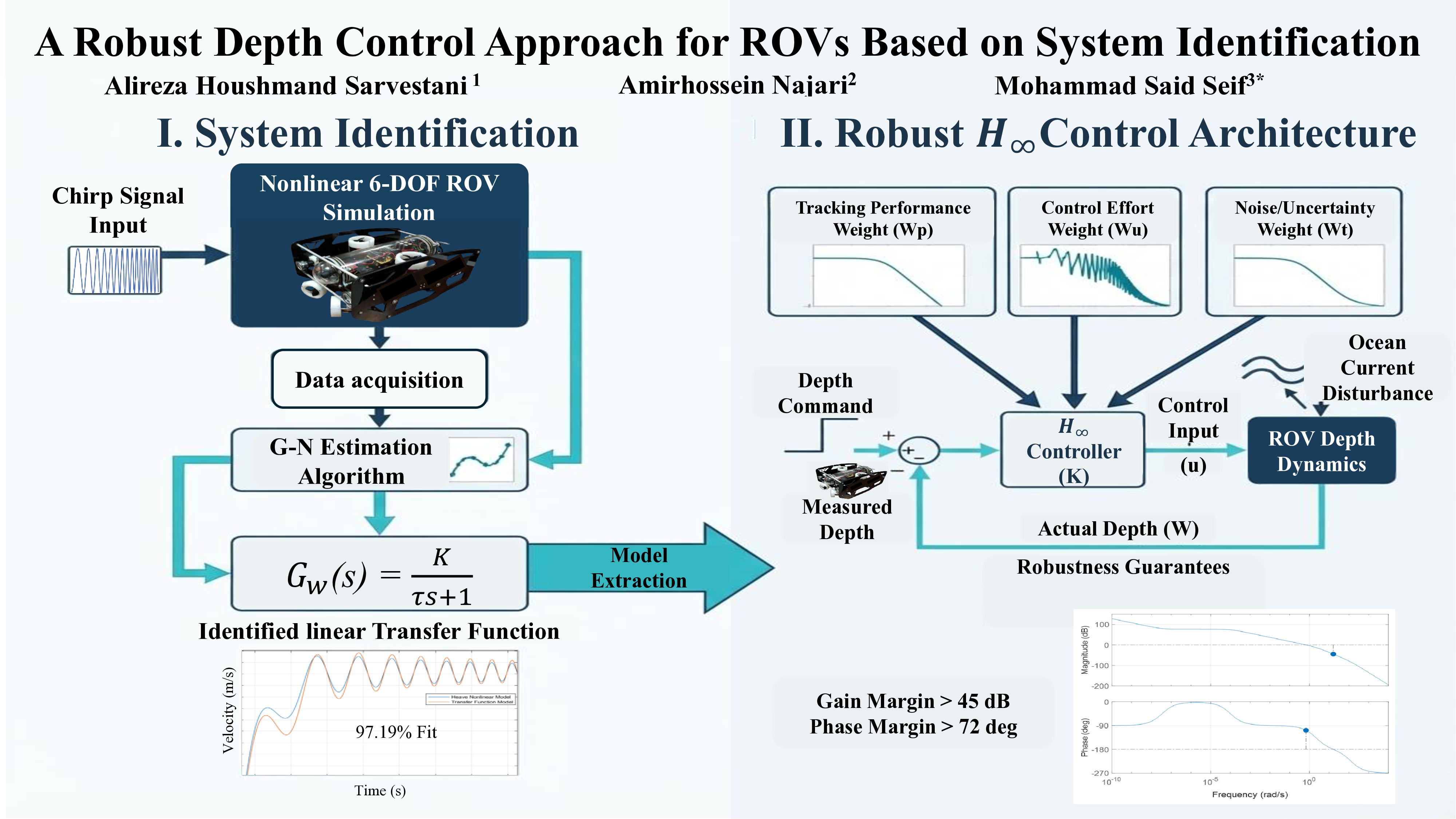
 : سنتز موفق کنترلکننده با حاشیه فاز ۷۲ درجه و حاشیه بهره ۴۵ دسیبل