1. [1] S. Jha and P. Dahiya, "Impact analysis of oil pollution on environment, marine, and soil communities," in Advances in Oil-Water Separation: Elsevier, 2022, pp. 99-113. [
DOI:10.1016/B978-0-323-89978-9.00017-3]
2. [2] T. Zhang et al., "Enhanced oils and organic solvents absorption by polyurethane foams composites modified with MnO2 nanowires," Chemical Engineering Journal, vol. 309, pp. 7-14, 2017. [
DOI:10.1016/j.cej.2016.08.085]
3. [3] M. M. Nuhu, E. R. Rene, and A. Ishaq, "Remediation of crude oil spill sites in Nigeria: problems, technologies, and future prospects," Environmental Quality Management, vol. 31, no. 4, pp. 165-175, 2022. [
DOI:10.1002/tqem.21793]
4. [4] V. Sharma, A. Ramish, and O. Sahu, "Oil spill recovery techniques in petroleum industry: a review on treatment process," J Oil Gas Petrochem Sci, vol. 3, no. 1, pp. 1-5, 2021.
5. [5] M. Fingas, "The challenges of remotely measuring oil slick thickness," Remote sensing, vol. 10, no. 2, p. 319, 2018. [
DOI:10.3390/rs10020319]
6. [6] B. Doshi, M. Sillanpää, and S. Kalliola, "A review of bio-based materials for oil spill treatment," Water research, vol. 135, pp. 262-277, 2018. [
DOI:10.1016/j.watres.2018.02.034] [
PMID]
7. [7] D. Angelova, I. Uzunov, S. Uzunova, A. Gigova, and L. Minchev, "Kinetics of oil and oil products adsorption by carbonized rice husks," Chemical Engineering Journal, vol. 172, no. 1, pp. 306-311, 2011. [
DOI:10.1016/j.cej.2011.05.114]
8. [8] K. Okiel, M. El-Sayed, and M. Y. El-Kady, "Treatment of oil-water emulsions by adsorption onto activated carbon, bentonite and deposited carbon," Egyptian journal of Petroleum, vol. 20, no. 2, pp. 9-15, 2011. [
DOI:10.1016/j.ejpe.2011.06.002]
9. [9] A. A. Al-Majed, A. R. Adebayo, and M. E. Hossain, "A sustainable approach to controlling oil spills," Journal of environmental management, vol. 113, pp. 213-227, 2012. [
DOI:10.1016/j.jenvman.2012.07.034] [
PMID]
10. [10] J. Pinto, A. Athanassiou, and D. Fragouli, "Surface modification of polymeric foams for oil spills remediation," Journal of environmental management, vol. 206, pp. 872-889, 2018. [
DOI:10.1016/j.jenvman.2017.11.060] [
PMID]
11. [11] J. O. Akindoyo, M. Beg, S. Ghazali, M. Islam, N. Jeyaratnam, and A. Yuvaraj, "Polyurethane types, synthesis and applications-a review," Rsc Advances, vol. 6, no. 115, pp. 114453-114482, 2016. [
DOI:10.1039/C6RA14525F]
12. [12] Q. Zhu et al., "Robust superhydrophobic polyurethane sponge as a highly reusable oil-absorption material," Journal of Materials Chemistry A, vol. 1, no. 17, pp. 5386-5393, 2013. [
DOI:10.1039/c3ta00125c]
13. [13] A. T. Hoang and M. Q. Chau, "A mini review of using oleophilic skimmers for oil spill recovery," Journal of Mechanical Engineering Research & Developments (JMERD), vol. 41, no. 2, pp. 92-96, 2018. [
DOI:10.26480/jmerd.02.2018.92.96]
14. [14] I. C. Ossai, A. Ahmed, A. Hassan, and F. S. Hamid, "Remediation of soil and water contaminated with petroleum hydrocarbon: A review," Environmental Technology & Innovation, vol. 17, p. 100526, 2020. [
DOI:10.1016/j.eti.2019.100526]
15. [15] D. Dave and A. E. Ghaly, "Remediation technologies for marine oil spills: A critical review and comparative analysis," American Journal of Environmental Sciences, vol. 7, no. 5, p. 423, 2011. [
DOI:10.3844/ajessp.2011.423.440]
16. [16] A. Dhaka and P. Chattopadhyay, "A review on physical remediation techniques for treatment of marine oil spills," Journal of Environmental Management, vol. 288, p. 112428, 2021. [
DOI:10.1016/j.jenvman.2021.112428] [
PMID]
17. [17] M. Khalil, I. El-Boghdady, and E. Lotfy, "Oil-recovery performance of a sponge-covered drum skimmer," Alexandria Engineering Journal, vol. 61, no. 12, pp. 12653-12660, 2022. [
DOI:10.1016/j.aej.2022.06.011]
18. [18] A. Hammoud and M. Khalil, "Performance of a rotating drum skimmer in oil spill recovery," Proceedings of the Institution of Mechanical Engineers, Part E: Journal of Process Mechanical Engineering, vol. 217, no. 1, pp. 49-57, 2003. [
DOI:10.1243/09544080360562981]
19. [19] A. Hammoud and M. Khalil, "Effect of disk material on disk skimmer performance," in Proceedings of the Second International Conference on Oil Spill in the Mediterranean and Black Sea Regions, Istanbul-Turkey 31st October-3rd November, 2000, pp. 153-164.
20. [20] V. Broje and A. A. Keller, "Improved mechanical oil spill recovery using an optimized geometry for the skimmer surface," Environmental science & technology, vol. 40, no. 24, pp. 7914-7918, 2006. [
DOI:10.1021/es061842m] [
PMID]
21. [21] V. Broje and A. A. Keller, "Effect of operational parameters on the recovery rate of an oleophilic drum skimmer," Journal of hazardous materials, vol. 148, no. 1-2, pp. 136-143, 2007. [
DOI:10.1016/j.jhazmat.2007.02.017] [
PMID]
22. [22] J. Ge et al., "Pumping through porous hydrophobic/oleophilic materials: an alternative technology for oil spill remediation," Angewandte Chemie, vol. 126, no. 14, pp. 3686-3690, 2014. [
DOI:10.1002/ange.201310151]
23. [23] A. T. Hoang, S. Nižetić, X. Q. Duong, L. Rowinski, and X. P. Nguyen, "Advanced super-hydrophobic polymer-based porous absorbents for the treatment of oil-polluted water," Chemosphere, vol. 277, p. 130274, 2021. [
DOI:10.1016/j.chemosphere.2021.130274] [
PMID]
24. [24] Z.-R. Jiang et al., "Coating sponge with a hydrophobic porous coordination polymer containing a low-energy CF3-decorated surface for continuous pumping recovery of an oil spill from water," NPG Asia Materials, vol. 8, no. 3, pp. e253-e253, 2016. [
DOI:10.1038/am.2016.22]
25. [25] N. Wang and Z. Deng, "Synthesis of magnetic, durable and superhydrophobic carbon sponges for oil/water separation," Materials Research Bulletin, vol. 115, pp. 19-26, 2019. [
DOI:10.1016/j.materresbull.2019.03.007]
26. [26] E. Piperopoulos, L. Calabrese, E. Mastronardo, C. Milone, and E. Proverbio, "Carbon-based sponges for oil spill recovery," in Carbon Nanomaterials for Agri-Food and Environmental Applications: Elsevier, 2020, pp. 155-175. [
DOI:10.1016/B978-0-12-819786-8.00008-6]
27. [27] A. T. Hoang, X. P. Nguyen, X. Q. Duong, and T. T. Huynh, "Sorbent-based devices for the removal of spilled oil from water: a review," Environmental Science and Pollution Research, vol. 28, pp. 28876-28910, 2021. [
DOI:10.1007/s11356-021-13775-z] [
PMID]
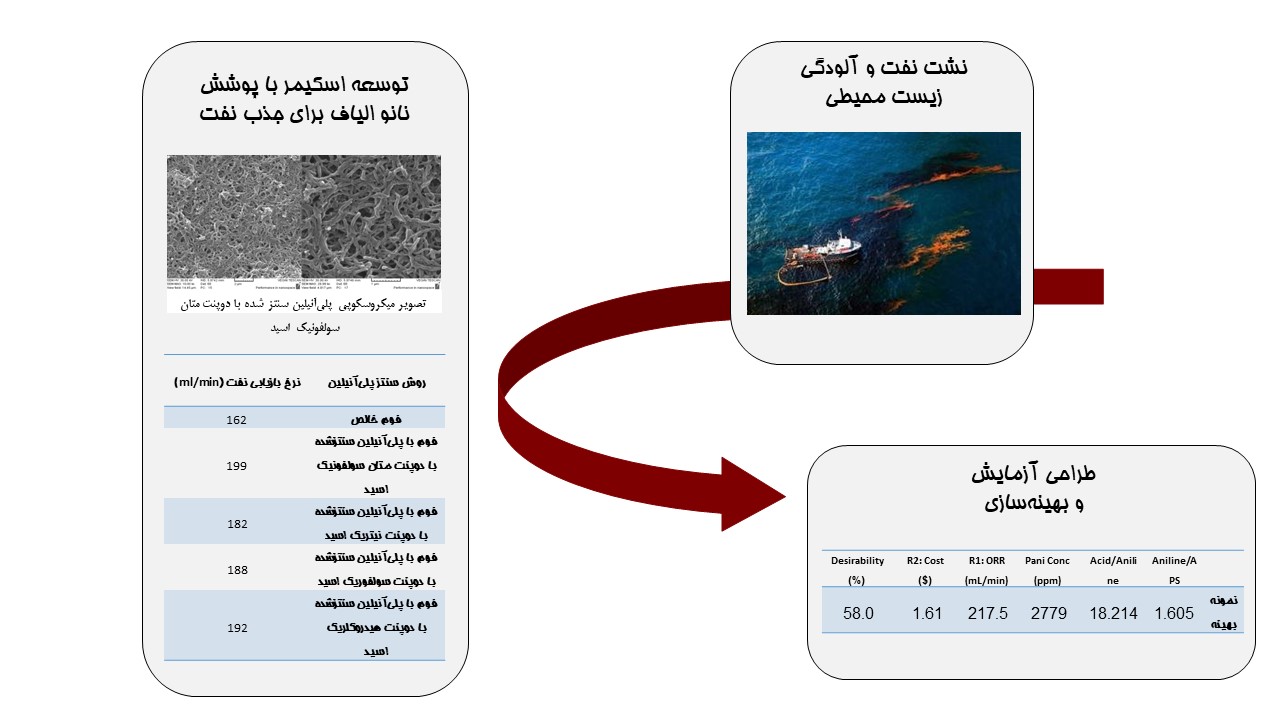
28. [28] A. Ghorbankhani and A. R. Zahedi, "Micro-cellular polymer foam supported polyaniline-nanofiber: Eco-friendly tool for petroleum oil spill cleanup," Journal of Cleaner Production, vol. 368, p. 133240, 2022. [
DOI:10.1016/j.jclepro.2022.133240]
29. [29] P. Taheri and A. R. Zahedi, "Techno-economic analysis of a renewable quadruple hybrid system for efficient water/biofuel production," Solar Energy, vol. 211, pp. 1053-1069, 2020. [
DOI:10.1016/j.solener.2020.10.040]
30. [30] M. Đorđević, Đ. Šabalja, Đ. Mohović, and D. Brčić, "Optimisation Methodology for Skimmer Device Selection for Removal of the Marine Oil Pollution," Journal of marine science and engineering, vol. 10, no. 7, p. 925, 2022. [
DOI:10.3390/jmse10070925]
31. [31] M. Trchová and J. Stejskal, "Polyaniline: The infrared spectroscopy of conducting polymer nanotubes (IUPAC Technical Report)," Pure and Applied Chemistry, vol. 83, no. 10, pp. 1803-1817, 2011. [
DOI:10.1351/PAC-REP-10-02-01]
32. [32] M. Bláha, M. Trchová, P. Bober, Z. Morávková, J. Prokeš, and J. Stejskal, "Polyaniline: Aniline oxidation with strong and weak oxidants under various acidity," Materials Chemistry and Physics, vol. 194, pp. 206-218, 2017. [
DOI:10.1016/j.matchemphys.2017.03.028]
33. [33] N.-R. Chiou, L. J. Lee, and A. J. Epstein, "Porous membrane controlled polymerization of nanofibers of polyaniline and its derivatives," Journal of Materials Chemistry, vol. 18, no. 18, pp. 2085-2089, 2008. [
DOI:10.1039/b719320c]
34. [34] L. Zhu, H. Lu, T. Huo, D. Liu, Z. Yan, and J. Zhang, "Superhydrophobic PDMS/MOF-74@ PU sponge with photothermal property for efficient oil/water separation," Separation and Purification Technology, vol. 364, p. 132525, 2025. [
DOI:10.1016/j.seppur.2025.132525]
35. [35] A. Zahedi, M. Aghaei, and B. Kanani, "Design of advanced skimmer coatings to improve marine oil spill recovery," Marine Pollution Bulletin, vol. 220, p. 118373, 2025. [
DOI:10.1016/j.marpolbul.2025.118373] [
PMID]




 ، علیرضا زاهدی*2